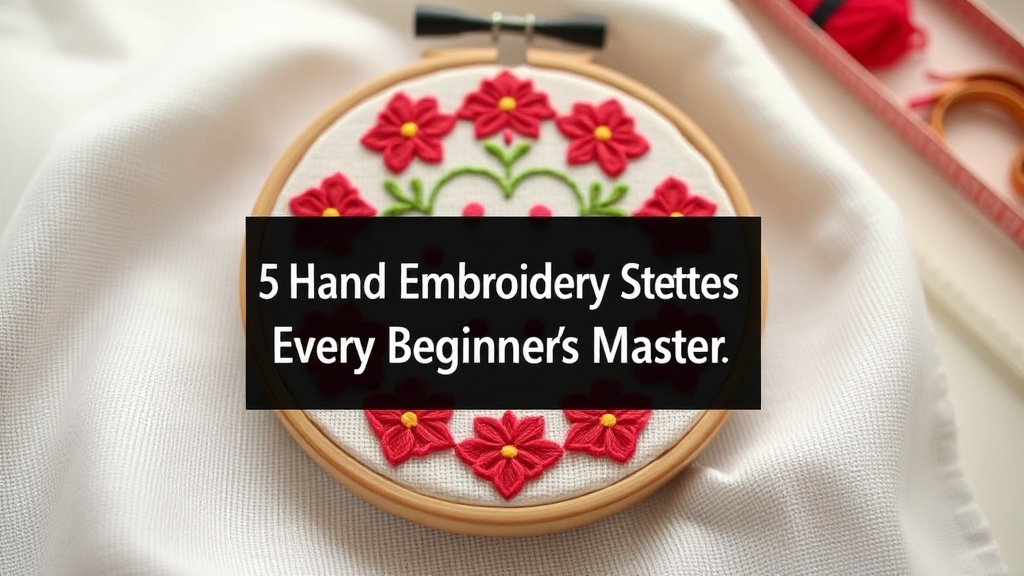
5 Essential Hand Embroidery Stitches Every Beginner Should Master
The Backstitch: Your Go-To Outline Stitch
Satin Stitch: Creating Smooth, Filled Shapes
French Knots: Adding Texture and Dimension
Stem Stitch: Perfect Curves and Lines
Lazy Daisy: Delicate Petals and Leaves
Hand embroidery opens up a world of creative possibilities with just a needle, thread, and fabric. This guide breaks down five foundational stitches that form the building blocks of nearly every embroidery project you'll encounter. Whether you're stitching a simple monogram on a tea towel or creating a detailed floral design for a wall hanging, these techniques will serve as your core toolkit. Master them, and you'll move from awkward fumbling to confident stitching in no time.
What Basic Hand Embroidery Stitches Should a Beginner Learn First?
Start with the running stitch, backstitch, satin stitch, French knot, and stem stitch. These five techniques cover the majority of beginner patterns and provide the foundation for more complex combinations later.
The running stitch earns its place as the most beginner-friendly technique in the embroidery world. It's the stitch you probably made as a child—up through the fabric, down through the fabric, repeat. That said, there's more nuance to a professional-looking running stitch than you might expect.
To execute it properly, bring your needle up from the back of the fabric, then push it down a short distance away. Come back up ahead of your last stitch, creating a dashed line effect. The key is consistency—aim for even spacing between stitches and gaps. Many beginners rush this stitch, resulting in a wobbly, uneven line. Take your time.
The running stitch works beautifully for outlining simple shapes, creating dashed borders, or even as a temporary basting stitch to hold fabric in place. Some embroiderers use it as a decorative fill stitch by working rows closely together. You'll find it in traditional Japanese sashiko work, where running stitches create geometric patterns on indigo-dyed fabric.
How Do You Do a Backstitch in Embroidery?
Work one stitch forward, then bring the needle up one stitch length ahead and insert it back into the end of the previous stitch—creating a continuous, unbroken line that resembles machine stitching.
The backstitch solves the running stitch's biggest weakness: gaps. When you need a solid line—for text outlines, sharp edges, or detailed contours—the backstitch delivers. It's stronger too, making it ideal for items that'll see regular use like pillowcases or clothing embellishments.
Here's the thing about backstitch technique: the motion feels backward (hence the name), but the result moves forward. Start with a single running stitch. Come up one stitch length ahead of where you went down. Now insert the needle back into the hole at the end of your first stitch. Pull through. You've just backstitched.
The catch? Tension matters enormously here. Pull too tight, and the fabric puckers. Too loose, and loops form on the surface. Practice on scrap fabric until the stitch sits flat and even. Most beginners find their rhythm after about twenty minutes of practice.
For outlining letters or intricate shapes, the backstitch reigns supreme. The DMC embroidery thread company recommends using three strands of their six-strand cotton floss for crisp outlines on standard quilting cotton.
What's the Difference Between Satin Stitch and Other Fill Stitches?
The satin stitch creates a smooth, solid surface by laying parallel stitches side by side without any gaps—unlike seed stitches or French knots which create texture, the satin stitch aims for a flat, fabric-like appearance.
This technique fills shapes with glossy, uninterrupted color. Leaves, petals, hearts, geometric blocks—anything that needs solid color coverage benefits from satin stitch. The visual effect resembles satin fabric (hence the name) when executed well.
The mechanics are straightforward but demanding. Bring your needle up on one edge of your shape, cross to the opposite edge, go down. Repeat, keeping stitches parallel and close together. The challenge? Keeping edges neat and preventing gaps while maintaining even tension across the entire shape.
Small shapes work best. Large filled areas tend to catch on things and can develop a "sagging" look over time. For bigger spaces, consider breaking them into smaller sections or using padding stitches underneath to add dimension.
Worth noting: the direction of your stitches dramatically affects the final look. Vertical satin stitches on a leaf look different than diagonal ones. Experiment on scraps before committing to your project.
| Stitch Type | Best For | Difficulty | Time Required |
|---|---|---|---|
| Running Stitch | Outlines, basting, simple borders | Beginner | Fast |
| Backstitch | Solid lines, text, detailed edges | Beginner | Moderate |
| Satin Stitch | Filling small shapes, solid color areas | Intermediate | Slow |
| French Knot | Texture, flower centers, dots | Intermediate | Moderate |
| Stem Stitch | Curved lines, vines, organic shapes | Beginner | Moderate |
Why Won't My French Knots Stay in Place?
French knots require wrapping the thread around the needle before reinserting it close to the entry point—most failures happen when the needle goes back down through the original hole or when the thread unravels during the wrap.
These tiny textured bumps add dimension to any embroidery piece. Flower centers, eyes on animals, polka dots, or scattered texture across a design—French knots deliver visual interest that flat stitches can't match. They're surprisingly versatile for their size.
The technique intimidates many beginners. Here's the breakdown: bring the thread up through the fabric. Hold the needle horizontally with your non-dominant hand. Wrap the thread around the needle twice (three times for larger knots). Keeping the wraps taut, reinsert the needle very close to—but not through—the original entry hole. Pull through slowly while holding the wraps in place.
Common problems include knots pulling through to the back (you didn't hold the wraps), lopsided knots (uneven tension), or knots that look messy (too many wraps). Practice on a separate scrap until the motion feels natural. The Royal School of Needlework suggests practicing with thicker thread initially—it's easier to control than single strands.
Many embroiderers combine French knots with other stitches for maximum effect. A satin stitch flower with a French knot center looks finished and professional. Scattered knots can suggest snowfall, stars, or simple texture on tree foliage.
Materials That Make Learning Easier
Quality supplies reduce frustration significantly. For beginners, DMC six-strand embroidery floss offers consistency and hundreds of color options. Anchor brand provides similar quality at comparable prices—both are widely available at craft stores like Michaels and Jo-Ann Fabric.
Needles matter more than you'd think. John James size 7 embroidery needles suit most beginners, with eyes large enough for thread but points sharp enough for precise work. Avoid dollar-store needles—the eyes often have burrs that shred thread and test your patience.
Fabric choice affects stitch visibility. Plain weave cotton (like quilting cotton or muslin) provides an easy-to-see grid for placing stitches. Avoid stretchy knits or slippery fabrics until you've built confidence. An embroidery hoop—wooden or plastic, whatever feels comfortable—keeps fabric taut and prevents puckering.
How Do You Keep Stem Stitches Curving Smoothly?
Work the stem stitch in a consistent direction along a line, keeping the working thread always to the same side (either always above or always below the needle) so the rope-like twist forms uniformly and follows curves without angling.
The stem stitch creates a rope-like, slightly twisted line perfect for organic shapes. Vines, stems, outlines with a hand-drawn quality—this stitch delivers. Unlike the backstitch's mechanical precision, the stem stitch carries a flowing, calligraphic character.
The secret lies in thread placement. As you work, the thread must stay consistently on one side of your needle—either the top or bottom, never switching. This creates the characteristic twist. Most right-handed embroiderers keep the thread to the left of the needle when working left-to-right; left-handers typically reverse this.
Small stitches curve better than long ones. When following a tight curve, shorten your stitch length. For gradual curves, longer stitches work fine. The stem stitch handles direction changes more gracefully than backstitch, making it ideal for natural, irregular shapes.
That said, the stem stitch isn't ideal for everything. Sharp corners look rounded. Straight lines can appear wobbly if your tension varies. Reserve it for flowing, organic elements where its character enhances the design.
Putting It All Together
These five stitches combine beautifully. Imagine a simple floral design: stem-stitched vines wind through the composition, backstitched leaves provide crisp definition, satin-stitched petals offer solid color, and French knots dot the centers. The running stitch might border the entire piece or fill a background area with dashed texture.
Start with small projects. A 4-inch hoop design using just running stitch and backstitch builds confidence. Add satin stitch on your second piece. Tackle French knots when you're ready for texture. By your fifth or sixth project, you'll reach for these stitches automatically—no pattern instructions required.
Embroidery rewards patience more than innate talent. The difference between sloppy and stunning work usually comes down to tension control and consistent stitch length—both improve with practice. Keep a "learning scrap" of fabric beside you to test unfamiliar combinations before committing them to your main project.
"The best embroidery tools are a sharp needle, good light, and the willingness to unstitch when something goes wrong."
Local needlework shops in Fredericton (like Wolseley Wool) stock beginner kits that include pre-printed fabric and all necessary supplies. These kits eliminate guesswork and provide immediate feedback on your progress. Online communities like Reddit's r/Embroidery offer troubleshooting help when you hit snags.
Your first stitches won't be perfect. That's normal. The slightly wobbly line or uneven knot carries more charm than machine precision ever could. Hand embroidery's beauty lies in its handmade quality—the evidence of human hands at work. Pick up your needle, thread it with color that makes you happy, and start stitching.