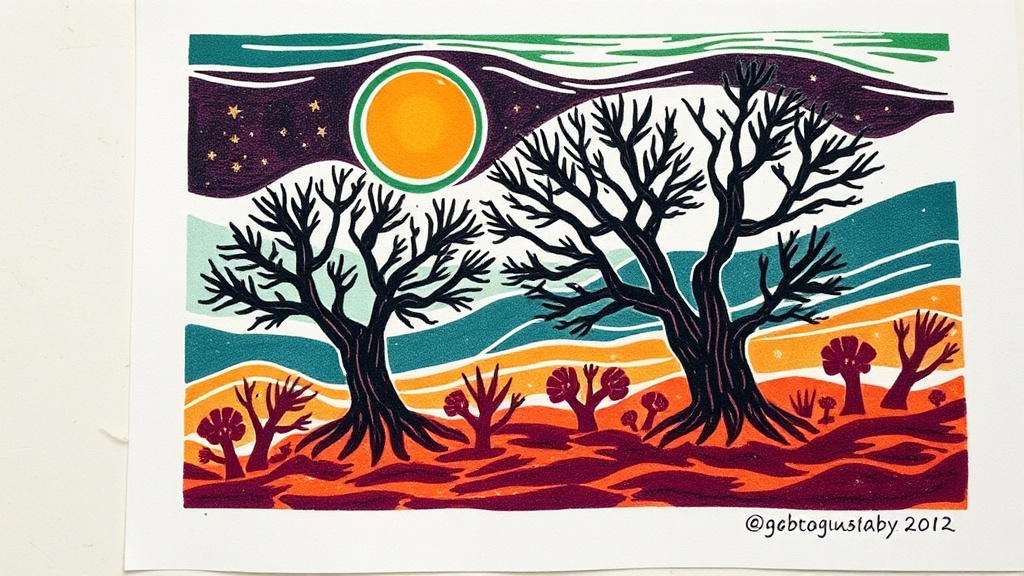
Making Your First Multi-Color Linocut Without a Press

You've just finished carving a intricate botanical design into a slab of grey battleship linoleum. The edges are crisp, the details are sharp, and you're ready to see it in color. You roll on a layer of deep forest green, press your paper down, and peel it back, only to realize that adding a second color—maybe a soft petal pink—feels like an impossible task. Without a massive, expensive cast-iron printing press, how do you get that second block to land exactly where it should? It is a common frustration for home-based printmakers, but you don't need a professional studio to create complex, multi-layered art. This guide looks at the multi-block method, showing you how to align your carvings and hand-print them using simple tools you probably already have in your kitchen or junk drawer.
What materials do you need for multi-block printing?
Before you start hacking away at your linoleum, you need to gather the right supplies. You'll need at least two blocks of the same size. While some artists prefer the soft, rubbery 'easy-cut' materials, traditional grey linoleum (the kind with the burlap backing) provides much more stability for multi-block work. It doesn't squish under pressure, which means your registration stays tighter. You also need a sharp set of carving tools—a small V-tool for fine lines and a wider U-gouge for clearing out large areas are fundamental. Dull blades are dangerous because they require more force, making them more likely to slip and slice your fingers (or ruin your design).
For the inking process, you'll want a sturdy rubber brayer (the roller) and some water-based or oil-based relief ink. Water-based inks dry faster, which is nice for quick projects, but oil-based inks often provide a richer color and more 'open time' to work. Since we aren't using a press, you'll need a baren or a simple wooden spoon to burnish the back of the paper. Finally, you need a way to keep everything in place. A registration jig—basically a corner frame made from scraps of wood or even heavy cardboard—is the secret to making sure every block hits the same spot on your paper every single time. You can find high-quality carving sets and various linoleum types at Jackson's Art if you're looking to upgrade your kit.
Step 1: Planning Your Color Separations
Multi-color printing requires you to think in reverse and in layers. Start by drawing your full-color design on a piece of paper. If you're doing a two-color print, decide which parts will be Color A and which will be Color B. Remember that where you carve away material, the paper will show through (white space). Where you leave the linoleum flat, it will pick up ink. Trace your master design onto a piece of transparent tracing paper. This tracing becomes your map for every block you carve. It is important to remember that your final print will be a mirror image of your carving, so if you have text, you must transfer it backward.
How do you align multiple blocks for a single print?
This is where most beginners get stuck. If your blocks aren't perfectly aligned, your colors will overlap in messy ways or leave awkward white gaps. The easiest way to handle this at home is the 'corner jig' method. Take a flat board and glue two strips of wood in an 'L' shape. When you're ready to print, you'll slide your linoleum block into that corner. Then, you'll tape your paper down along one edge so it acts like a hinge. You can lift the paper, swap out the block for the next color, and drop the paper back down in the exact same position. This keeps the paper-to-block relationship consistent throughout the entire run.
Another popular method is the T-bar registration. You mark a 'T' shape on the back of your paper and a matching 'T' on your registration board. This is a bit more fiddly but works well if you're printing on very large sheets of paper that don't fit in a small corner jig. Regardless of the method, the goal is to eliminate the guesswork. You should be able to close your eyes and place the block in the right spot just by feeling the edges of your jig. If you're interested in more advanced registration techniques, Handprinted has some fantastic deep dives into professional setups.
Step 2: Transferring and Carving
Once your map is ready, flip your tracing paper face down onto the first block. Rub the back of the tracing paper with a pencil or a bone folder to transfer the graphite lines onto the linoleum. Repeat this for the second block. Now you have two identical outlines. On Block 1, carve away everything except the areas you want for your first color. On Block 2, carve away everything except the areas for your second color. Keep your non-carving hand behind the blade at all times—linoleum can be stubborn, and the tool can jump forward unexpectedly. (I've seen many a thumb fall victim to a slip-up, so take your time and don't rush the process.)
Step 3: The Inking Process
Squeeze a small amount of ink onto a glass plate or a specialized inking tray. Use your brayer to roll the ink out until it makes a soft, 'hissing' or 'velvety' sound. This indicates you have a thin, even layer. If the ink looks like orange peel texture, you have too much on the roller, which will fill in your fine carved lines and make the print look muddy. Roll the ink onto your first block in multiple directions—up, down, and diagonally—to ensure full coverage. You want the surface to look wet and shiny but not gloopy.
Can you get professional results without a printing press?
Absolutely. While a press applies thousands of pounds of even pressure, your hands and a wooden spoon can do a surprisingly good job if you're methodical. Once you've inked your block and placed it in your jig, lower your paper onto the surface. Starting from the center and working outward, use your baren or the back of a smooth wooden spoon to rub the paper. You'll need to use firm, circular motions. You can usually see the image start to 'ghost' through the back of the paper as the ink transfers. Be careful not to let the paper shift while you're rubbing, or you'll end up with a double-image (ghosting).
The beauty of hand-burnishing is that you can lift a corner of the paper to check the progress. If a spot looks light or patchy, just lay the paper back down and rub that area some more. This level of control is something you actually lose when using a mechanical press. It takes more physical effort, and your shoulder might be a bit sore after a long printing session, but the results have a handmade warmth that is hard to replicate with a machine. Plus, there's something deeply satisfying about the tactile nature of feeling the ink transfer through the grain of the paper.
Step 4: Layering the Second Color
After your first color is dry (which can take anywhere from a few hours to a few days depending on the ink), it's time for the second layer. Clean your jig and your brayer thoroughly. Place your second carved block into the corner of the jig. Ink it up with your second color. Using the same hinge method as before, lower your paper onto the new block. Because your paper was taped down or aligned to the same corner, the second color should land perfectly on top of the first. Peel the paper back slowly to reveal the finished multi-color print. It's a bit like magic every time the layers finally click together.
Don't get discouraged if your first few prints are slightly off. Printmaking is a craft of repetition and fine-tuning. Maybe your jig needs to be a bit tighter, or maybe you need to use less ink. Every mistake is just a piece of data helping you understand how the materials behave. The more you print, the more you'll develop a 'feel' for the right amount of pressure and the perfect ink consistency. Stick with it, keep your tools sharp, and enjoy the rhythmic, meditative process of carving and printing at your own pace.